Alocasia Plant Care: Watering, Leaf Loss & New Growth
Updated · Sproutly
Give an indoor Alocasia a bright position, warmth and a pot that drains. Water according to the moisture in its root ball, then adjust as growth speeds up or slows down. A yellow leaf is a reason to check conditions, not proof that the plant needs a humidifier.
Start with the root zone and window
| Factor | Starting point | What to check next |
|---|---|---|
| Light | Bright, mostly indirect daylight | Avoid suddenly putting a shade-grown plant in strong afternoon sun. |
| Water | Water as the surface begins to dry, while the root zone retains some moisture | Check deeper before watering; a dry surface can cover a saturated core. |
| Pot and mix | Drainage holes and a mix that holds some water while allowing air | An oversized pot or a dense inner nursery plug can stay wet after the edges dry. |
| Temperature | A warm, stable room; RHS advises keeping indoor plants above 16°C / 61°F | Cold windows and drafts can be much colder than the room thermostat. |
| Humidity | Measure at plant height before making changes | Different species and cultivars respond differently; there is no universal 60% survival threshold. |
Place the plant where you can reach it easily. Lifting the pot after watering and again as it dries gives you a useful comparison. Record the moisture and light when a new leaf starts: that context is more useful than copying another grower’s weekly schedule.
Know which Alocasia you have
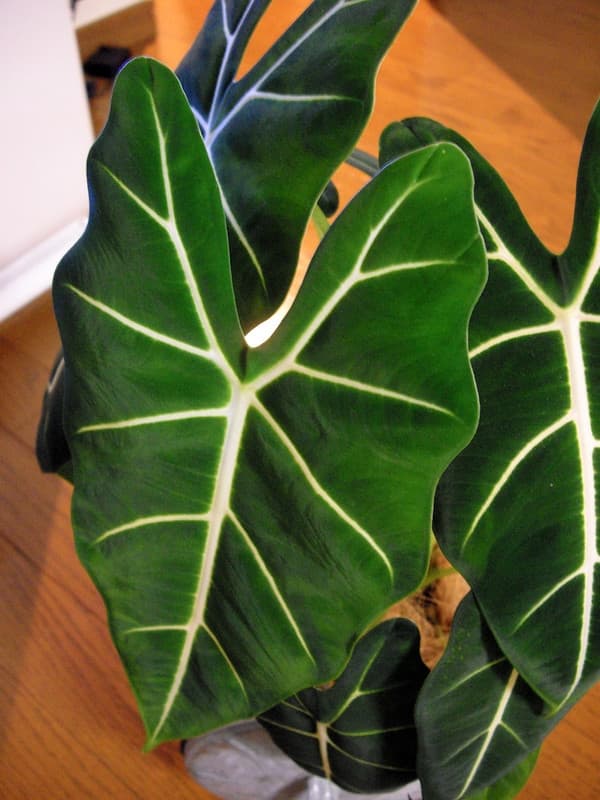
An Alocasia labelled ‘Green Velvet’ in NC State’s collection. Leaf texture and shape help narrow an identification; a pale-veined leaf alone does not establish a cultivar.
Photo: Masaaki Kormori / NC State Extension. CC BY-SA 2.0. Resized for display.
Alocasia is a genus, so a compact Black Velvet and a large elephant ear should not be expected to occupy the same space or dry at the same rate. NC State’s genus profile illustrates these differences.
- Black Velvet: compact growth with thick, dark, velvety leaves and contrasting veins.
- Zebrina: conspicuous striped leaf stalks; the stripes are a more useful clue than green arrow-shaped leaves alone.
- Dragon Scale: strongly textured leaves with a different surface from the velvety types.
- Polly and related hybrids: compare the label, leaf outline and margins; nursery trade names are not always used consistently.
Water without keeping the roots stagnant
- Check both surface and core. Feel just below the surface and compare pot weight. If you use a wooden probe deeper in the mix, insert gently away from the crown. Do not water a heavy, still-wet pot merely because the top looks pale.
- Wet the root ball evenly when needed. Let excess water leave the drainage holes. Empty the decorative outer pot rather than letting the nursery pot stand in runoff.
- Recheck as conditions change. A plant making several leaves in warm, bright conditions may use water quickly. A plant with fewer leaves in a dim winter room may use much less.
Choose a container close to the size of the healthy roots. A moisture-retaining potting base with suitable aeration material can work; there is no single required recipe. Very coarse mixes in small pots can dry too fast, while a large pot of dense mix may stay wet for too long. Repot to solve an actual drainage or root-space problem, not automatically on arrival.
Feed only while the plant is actively growing, following the fertilizer label. Fertilizer cannot repair rotten roots or compensate for inadequate light. Pause feeding while you investigate a declining plant.
Work through yellow leaves in order
| Pattern | Check first | Next step |
|---|---|---|
| One older outer leaf fades; the rest are firm | Is new growth healthy and are losses occasional? | Remove the leaf once spent and observe. Normal aging is possible, but it is not a fixed one-in, one-out rule. |
| Several leaves yellow; pot stays wet | Drainage, concealed standing water and root condition | If decline continues or the base softens, inspect the roots and use the rescue guide. |
| Drooping leaves; pot is very light and dry | Whether water has bypassed a dried-out root ball | Rewet evenly, drain and watch for recovery before changing other conditions. |
| Fine pale speckling or webbing | Leaf undersides, stalk junctions and nearby plants | Isolate and identify pests before treatment; humidity alone will not solve an infestation. |
| Crisp edges with otherwise firm growth | Watering fluctuations, heat, salts and measured humidity | Compare observations before buying equipment. Brown edges have several possible causes. |
There is no dependable four-to-seven-leaf ceiling for every Alocasia. Leaf number reflects plant size, species, resources and recent stress. Losing an old leaf as a new one opens does not by itself prove either perfect health or disease.
When growth slows or all the leaves disappear
Shorter days and cooler conditions can slow growth or lead to leaf loss. An indoor plant kept warm under adequate light may behave differently from one beside a cold winter window. Do not diagnose dormancy from the calendar alone.
A firm underground stem or corm is worth keeping; soft, collapsing tissue needs investigation. With little foliage, water demand is lower. Keep the remaining root zone from staying sodden, but do not impose a fixed period of complete drought on a plant that still has living roots. Reassess gently as buds or new growth appear. Repeatedly digging up the corm makes recovery harder to judge.
For propagation, separating an established offset with its own growth point and roots is usually easier to monitor than starting a tiny corm. A detached leaf and stalk without the necessary basal growing tissue will not become a new Alocasia. Wear gloves when dividing or pruning: the plant’s sap can irritate skin, and it should not be chewed.
Frequently Asked Questions
There is no universal 60% minimum for every Alocasia. Many appreciate more humidity than a very dry room offers, but first measure the air and check watering, roots, light and pests. Higher humidity should not mean condensation or stagnant, persistently wet conditions.
A fully yellow, spent leaf can be removed with clean tools. If several leaves are yellowing, also investigate the cause. Removing leaves alone will not fix a wet root ball or pests.
It may regrow if its underground growing tissue remains firm and healthy. Check for decay and adjust watering to the reduced foliage. Neither a fixed recovery date nor the word dormancy can establish whether it will recover.
Misting does not give reliable control of room humidity. Use a hygrometer, address hot or drying drafts, and only increase humidity if observations support it. Avoid keeping foliage and surrounding surfaces wet.
Sources & further reading
- RHS: growing Alocasia indoors
- NC State Extension: Alocasia characteristics and cultivars
- Clemson Extension: houseplant diseases and disorders
This guide combines the references above with practical decision steps for home growers. Conditions and cultivars vary. How we approach plant guidance · Suggest a correction