Plant Identifier Quiz: Compare Common Houseplants
Updated · Sproutly
Look at the whole plant, a mature leaf and the point where that leaf joins the stem. Answer five questions to get a shortlist from 24 named plant profiles. You can choose “not sure” at every step. Results suggest what to compare next; they do not confirm a species or cultivar.
Make useful comparisons
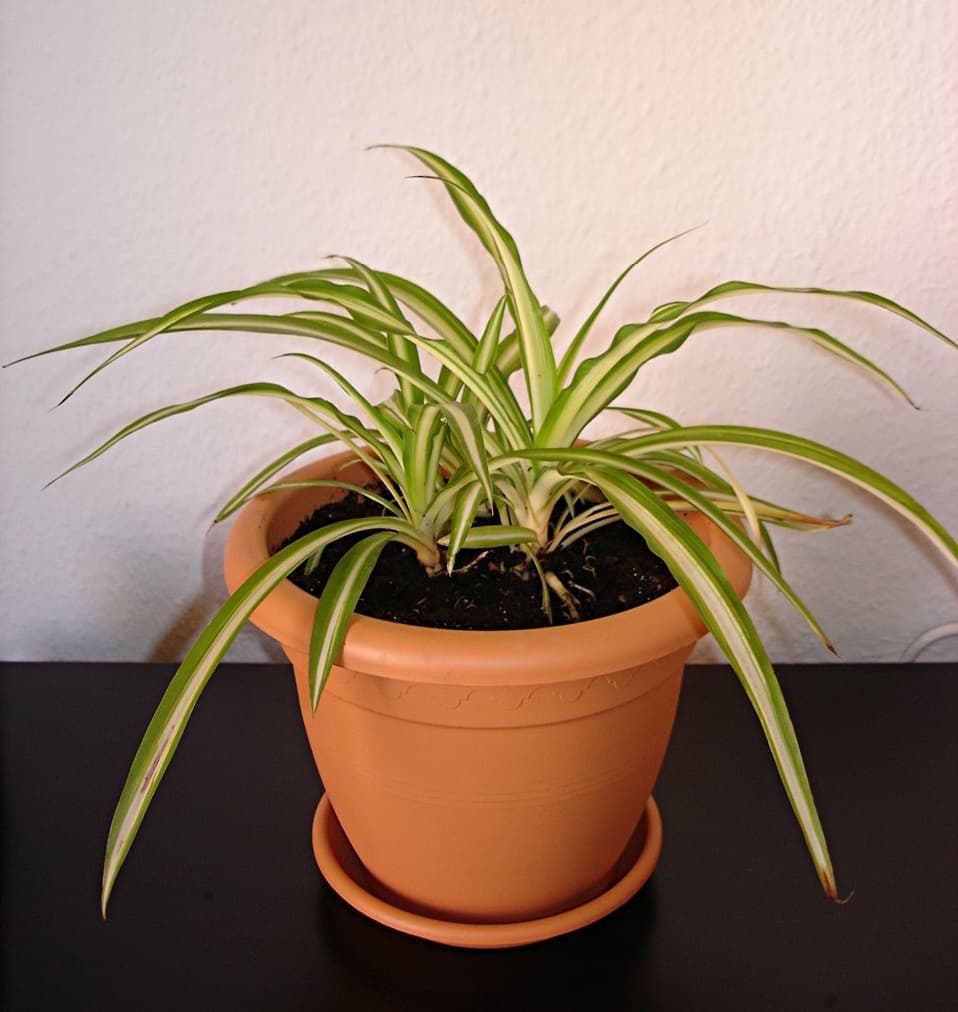
A spider plant has flexible, arching leaves. A snake plant can also have striped strap-shaped leaves, but they are generally much firmer. Compare the structure and surface, not the stripe alone.
Photo: Nguyễn Dương Khang; crop by Sciencia58 / Wikimedia Commons. CC BY-SA 2.5. Resized for display.

| Lookalikes | Useful clue | Why one feature is not enough |
|---|---|---|
| Pothos / heartleaf philodendron | Check the groove on the pothos leaf stalk and the separate new-growth sheath on heartleaf philodendron. | Both can have green heart-shaped leaves and climb or trail. |
| Spider plant / snake plant | Compare flexible, arching foliage with firm, thicker leaves; spider plants may carry babies on runners. | A young spider plant may have no babies, and both groups can be striped. |
| Peace lily / other broad-leaved aroids | Follow leaf stalks to the basal clump and examine venation; flowers add another clue. | Several aroids produce a pale spathe around a spike. |
| Young Monstera / another climbing aroid | Compare nodes, mature leaves and the entire growth habit. | A juvenile Monstera can have unsplit leaves. |
Keep the plant intact while checking. A useful identification does not require tasting it, snapping stems or exposing sap. Confirm the botanical name independently before using an identification to decide pet safety, edibility or treatment.
Take the photos that resolve uncertainty
- Whole plant: include the pot, base, tallest growth and any trailing stems. This shows whether it is a clump, vine, rosette or woody plant.
- One mature leaf: photograph the top and underside in neutral daylight, with a ruler beside it for scale.
- Leaf attachment: show where the stalk joins the main stem. Include the next node and any sheath, bud or aerial root.
- Distinctive features: photograph flowers, plantlets, hairs, raised markings or natural leaf holes without damaging them.
- Label and history: keep the nursery tag and note whether the plant recently changed shape, lost leaves or grew under very low light.
Compare these views with a botanical reference, or show them to a nursery or local extension service. A single close-up of a leaf often hides exactly the feature that distinguishes two candidates.
How the shortlist works
The quiz compares your observations with the visible-trait profiles listed below. A candidate must agree with the leaf shape, growth structure and extra feature you selected. Texture and color then help order compatible candidates. All candidates tied for the strongest support are shown.
“Not sure” contributes no evidence. If there are too few useful clues, or none of the profiles supports the combination, the tool asks you to look again rather than forcing a name. Some profiles represent a species, while others explicitly represent a broader group; the collection is not an estimate of what percentage of household plants we can identify.
This is a rule-based comparison tool. Its ordering is not a measured accuracy rate or a probability. Cultivars, immature growth, unusual species and incorrect observations can all fall outside the simplified profiles.
Plants in this comparison collection
Use these reference pages to inspect other photographs and diagnostic features. A profile covering a group does not promise identification of every species in that group.
- Monstera deliciosa
- Monstera adansonii
- Pothos
- Heartleaf philodendron
- Satin pothos (Scindapsus pictus)
- Snake plant
- Spider plant
- Peace lily
- Alocasia (group)
- Arrowhead plant (young Syngonium)
- Fiddle-leaf fig
- Rubber plant
- Jade plant
- Aloe vera
- Echeveria (group)
- Zebra haworthiopsis
- ZZ plant
- Dragon tree
- Boston fern
- Parlor palm
- Croton
- Purple passion plant
- African violet
- Prayer plant (Maranta leuconeura)
Frequently Asked Questions
This tool is a visual quiz. It does not upload or analyze photographs. You can keep a photo beside you while answering, and use the photo checklist to gather views that make comparison more useful.
Many houseplants share broad features. The tool shows all profiles tied for the strongest support from your answers and gives another feature to check for each. A single leading result is still a possibility to verify, not a confirmed identification.
Choose “not sure / something else.” The tool only covers its listed collection, and juvenile or unusual plants may not fit it. Photograph the plant base, leaf attachment, both leaf surfaces and any flowers for comparison with a broader reference or a knowledgeable nursery.
The quiz compares visible traits using simple rules. Those rules have not been validated as probabilities against a labelled identification dataset. A percentage would suggest a level of certainty the tool cannot establish.
Compare several features, especially the leaf stalk and developing growth. Pothos has a grooved petiole; heartleaf philodendron has a separate protective sheath around emerging growth. Both can have heart-shaped leaves, and leaf color alone is unreliable.
Sources & further reading
- NC State Extension: pothos and its distinguishing features
- NC State Extension: heartleaf philodendron
- NC State Extension: spider plant
- NC State Extension: peace lily
This guide combines the references above with practical decision steps for home growers. Conditions and cultivars vary. How we approach plant guidance · Suggest a correction