Croton Plant Care: Leaf Color, Watering & Leaf Drop
Updated · Sproutly
A croton (Codiaeum variegatum) needs a bright position and a root ball that drains between waterings. When it drops leaves, check recent changes, soil moisture, cold exposure and pests in that order. Do not respond to every falling leaf with more water or higher humidity.
Recognize healthy color and growth
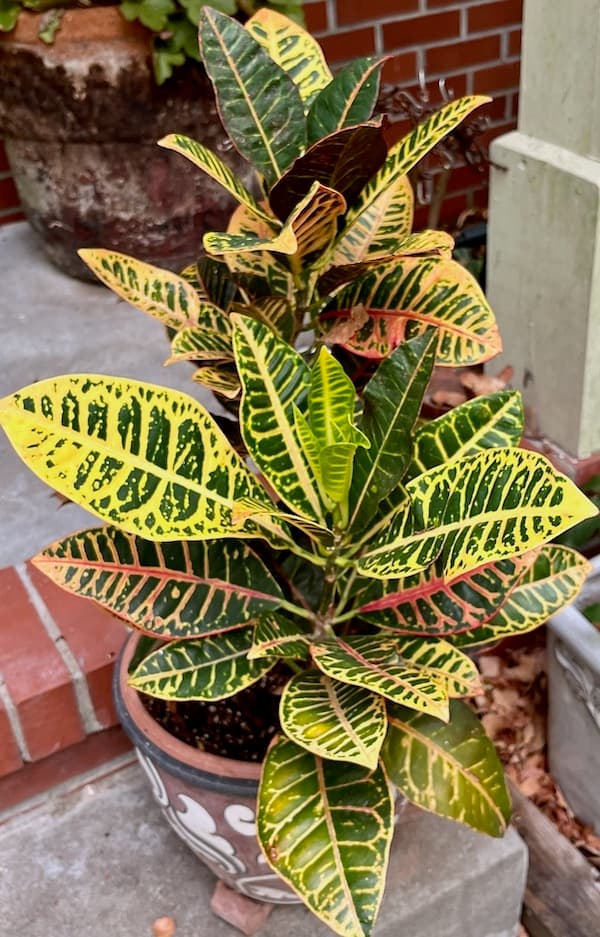
Croton leaves can carry several colors on the same plant. Compare the condition of new growth with older leaves instead of treating every yellow marking as a watering symptom.
Photo: Joanne Kollar (Pitt County) / NC State Extension. CC BY 4.0. Resized for display.
Healthy variegation forms part of a leaf’s pattern. A leaf that loses firmness, yellows across its surface and falls is a different observation. Note the pattern, age and position of affected leaves before choosing a remedy.
Names such as Petra and Gold Dust describe different selections. Leaf shape alone does not tell you how much drought a plant tolerates. A curled-leaf croton still needs the same moisture checks as one with flat leaves.
Give color enough light
Crotons need bright light for good color and can tolerate some direct sun after acclimation. A nursery-grown plant moved suddenly into hot afternoon sun can scorch, even though a plant established in that location may grow well.
- Start near a bright window. Check whether a roof overhang, tree, balcony or sheer curtain blocks much of the sky.
- If the position is much sunnier than the old one, introduce the exposure gradually. Watch the leaves facing the glass for bleached or crisp patches.
- Evaluate the next leaves. An old leaf does not have to change color immediately for the new position to be helpful.
Choose a location you can keep reasonably stable. Rotating a pot gently to balance growth is different from moving it between a dim room and a sunny balcony. There is no useful universal rule that a 90-degree turn causes leaf drop.
Water from the root ball, not a weekly reminder
Check below the surface and compare pot weight. If the surface has started to dry and the pot is no longer wet through its core, water evenly and let the excess drain. Empty the saucer or cachepot. Avoid repeatedly giving small splashes that leave the lower root ball either dry or stale.
| Observation | What it suggests | What to do |
|---|---|---|
| Surface dry, pot heavy, deeper mix wet | The core has not dried as much as the surface | Wait and check drainage before watering again. |
| Leaves droop, pot very light, mix dry | Water shortage is plausible | Water evenly, drain, then reassess. |
| Leaves droop, mix stays saturated | Root function may be impaired | Look for standing water and investigate persistent decline. |
| Water runs straight down the sides | Dry mix may be repelling water or roots may fill the pot | Rewet in slow passes; inspect root space if the pattern persists. |
Use a draining pot close to the healthy root system’s size. Repot when roots are crowded or the mix has stopped functioning well. Moving a struggling croton into a much larger container can extend the time its roots spend wet.
Feed during active growth according to the product label. Pause while investigating root damage or leaf loss. Fertilizer is not a substitute for suitable light, and more fertilizer will not reliably create brighter variegation.
A leaf-drop checklist for the first week
- Write down what changed. Delivery in cold weather, a new window, repotting or a missed watering are more useful clues than the word “stress.”
- Check the pot today. Remove the nursery pot from its cover and look for trapped water. Feel the mix rather than assuming leaf drop means thirst.
- Check temperature at the plant. Avoid cold drafts and glass contact. A warm room can contain a chilly window ledge; protect outdoor plants before cold nights.
- Inspect both sides of the leaves. Fine pale speckling and webbing suggest mites; sticky patches or bumps need closer pest identification. Isolate a suspicious plant.
- Track the trend. After correcting a clear problem, count new losses and inspect buds. Repeatedly moving, repotting and treating the plant makes the cause harder to establish.
If stems remain firm and buds remain viable, a partly bare plant may recover. Softening stems, damaged roots or continued rapid decline need a closer inspection. Do not promise regrowth in a fixed number of weeks.
Keep humidity in perspective
NC State Extension’s croton profile describes low to medium relative humidity, which does not support calling 50–80% a universal requirement. Crotons can experience dry-air stress, but “the higher the better” is poor advice for a home.
Measure near the plant before adjusting the room. Check hot drafts, inconsistent watering and spider mites as well. If you use a humidifier, monitor the result and avoid persistent condensation; a closed, wet corner is not a necessary croton setup. EPA household guidance recommends keeping indoor relative humidity below 60%, ideally 30–50%.
Pruning and propagation
Wear gloves and protect surfaces from sap. To encourage a branch, prune a healthy stem just above a node, leaving enough foliage to support the plant. Resolve an active root or pest problem before major reshaping.
For a cutting, retain a piece of healthy stem with nodes and some leaves; do not rely on a detached leaf alone to produce a new shrub. Root it in a warm, bright but shaded position in an appropriate propagation medium. Air layering is another option for a large, woody stem. Keep cuttings labelled and away from children and pets, and wash tools after use.
Frequently Asked Questions
A change in light, moisture or temperature may be involved, but check the actual pot and foliage. Cold transport, standing water, a dried root ball and pests need different responses. Choose a bright, stable position and monitor new losses after correcting the identified problem.
Yes, some direct sun can support good color, but acclimate a plant gradually when moving it into stronger exposure. The intensity through a hot window and the plant’s previous growing conditions matter.
Not automatically. Measure humidity and investigate watering, drafts and pests before adding one. There is no universal requirement for 50–80% humidity, and sustained indoor dampness is undesirable.
Healthy stems with viable buds can produce new growth after the cause of leaf loss is corrected. Soft or dead stems cannot. Check stem and root condition rather than relying on a fixed recovery timeline.
Sources & further reading
- NC State Extension: Codiaeum variegatum, light and cultivar details
- Clemson Extension: distinguishing houseplant disorders
- US EPA: humidity and moisture in the home
- University of Missouri Extension: stem cuttings and air layering
This guide combines the references above with practical decision steps for home growers. Conditions and cultivars vary. How we approach plant guidance · Suggest a correction